Frozen Pipes in Boise: How to Thaw Them Safely and What to Do If One Bursts
Short answer
**Where is my main water shutoff?** Most Boise-area homes have it where the water line enters the house (basement, crawl space access, garage, or a utility closet), or at a street-side meter box; find and test it before you need it. **Is it safe to thaw a pipe with a torch?** No. Open flame near pipes, wood framing, and insulation can ignite a structure fire and can scorch or weaken the pipe itself; use gentle heat sources instead. **Why do pipes freeze in Boise homes?** Pipes in unheated or under-insulated spaces — crawl spaces, garages, exterior walls, attics — lose heat fast during a hard cold snap, and the water inside can freeze and expand until the pipe cracks or splits. **What should I do first if a pipe bursts?** Shut off the main water valve immediately, then turn off power to any affected electrical circuits if it's safe to reach the panel, and start moving water away from floors and belongings. **How long does it take frozen pipes to burst?** It depends on insulation, wind exposure, and how cold it gets, but a sustained hard freeze (teens or lower) over several hours is often enough in an exposed crawl space or exterior wall.
Water or fire damage right now?
Call any time of day. If you would rather not talk yet, send a few photos and tell us what happened.
Fire, gas smell, or a risk of electric shock: leave the building and call 911 first.
Why Boise pipes freeze when the temperature drops
Boise winters bring stretches of hard cold, especially when an arctic air mass settles into the valley for several days. Daytime highs can stay below freezing and nights can dip well into the teens or single digits. That kind of sustained cold is what causes trouble — a few cold hours rarely freezes a pipe, but a multi-day cold snap will find every weak spot in a home's insulation.
The most common trigger we see is a cold snap reaching an unheated crawl space. Crawl spaces are often vented, poorly insulated, or have gaps around access doors and vents that let outside air in directly. Pipes running through that space can sit just inches above frozen ground with little buffer against the cold air moving through. Garages, exterior-wall plumbing (especially on the north side of a house), and attic lines feeding a bathroom above a garage are the next most common spots.
When water freezes inside a pipe, it expands. That expansion pushes against the pipe walls until something gives — usually not at the ice itself, but at a joint or section of pipe downstream where pressure has built up. That is why a burst often shows up somewhere other than where the ice actually formed.
Before a freeze: steps that actually help
- Know where your main shutoff is and confirm the valve turns (see the FAQ below).
- Insulate exposed pipes in the crawl space, garage, and attic with foam pipe sleeves.
- Seal obvious gaps or open vents on crawl space access points before a hard freeze.
- Disconnect and drain outdoor hoses, and shut off exterior hose bibs if they have an interior valve.
- During a hard freeze, let cold-side faucets on exterior walls drip slightly and open cabinet doors under sinks on exterior walls so warmer room air can reach the pipes.
- Keep the thermostat set to a consistent temperature overnight rather than turning the heat down low; a steady indoor temperature protects pipes in walls better than a big swing.
How to find a frozen pipe
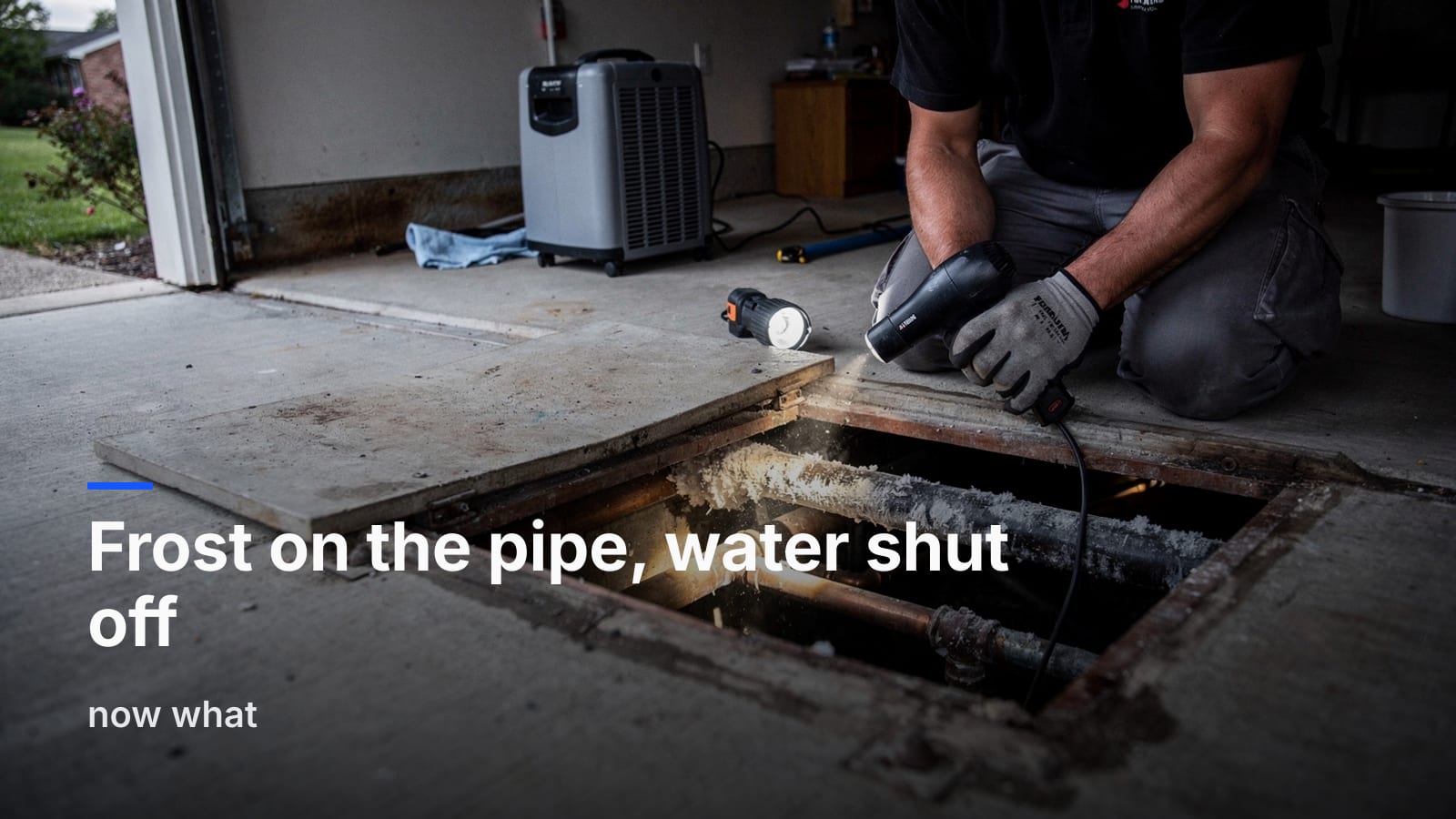
A frozen pipe usually shows up as a faucet with little or no flow, often paired with frost or unusually cold metal on an exposed section of pipe. Check the most likely spots first: under sinks on exterior walls, where a line enters from the crawl space, and any exposed run in a garage or attic. If you can see frost on the outside of the pipe, that is a strong sign the ice is right there.
If you cannot find a visibly frozen section but a fixture has no flow, the blockage may be inside a wall or under the floor where you cannot reach it. In that case, warming the general area (the room, not an open flame directed at a wall) and waiting is usually the safer option.
Safe ways to thaw a pipe
- Open the faucet fed by the frozen section first, even just a crack. This relieves pressure as the ice melts and gives you an early sign that water is moving again.
- Apply gentle, steady heat to the pipe using a hair dryer on a low setting, a space heater kept a safe distance away and never left unattended, or towels soaked in hot water wrapped around the pipe.
- Work from the faucet end toward the blockage. Thawing from the middle of a frozen section first can trap pressure between two ice plugs.
- Be patient. Thawing can take anywhere from a few minutes to over an hour depending on how long the pipe has been frozen and how accessible it is.
- Stop and call for help if the frozen section is hidden inside a wall, floor, or ceiling, or if you smell gas, see scorching, or suspect the pipe has already cracked.
What not to do
Never use an open flame — a propane torch, a camp stove, or anything similar — to thaw a pipe. The heat is uneven and hard to control, it can ignite nearby wood framing, insulation, or dust, and it can scorch or weaken the pipe material itself, especially on copper joints or any plastic fitting. House fires started this way are a known risk during cold snaps, and it is not worth it.
Also avoid:
- Boiling water poured directly onto a pipe (the sudden temperature change can crack it)
- Leaving a space heater unattended near insulation or wood
- Hammering or forcing a frozen section to try to break the ice loose
- Ignoring a slow drip or discoloration near a joint once the pipe has thawed — that can mean a crack is already there and about to let go under full pressure
If a pipe bursts
- Shut off the main water valve immediately. This stops the flooding at the source and matters more than anything else in the first minutes.
- Cut power to affected areas if you can do so safely — from the breaker panel, not by touching anything wet. If the panel itself is wet or you are unsure, stay out and call an electrician or utility for help.
- Move people and pets away from standing water near outlets, switches, or any ceiling that is sagging or dripping from above — a wet ceiling can mean water pooling in a light fixture, which is an electrical hazard.
- Start removing standing water with towels, a wet/dry shop vac, or buckets, and move furniture, rugs, and boxes off wet flooring.
- Open windows or run fans if the weather allows, to start air moving, but don't rely on this alone — Boise's cold, dry winter air actually helps evaporation once heat is on, but wet insulation and subfloor material dry very slowly without equipment.
- Take photos of the water line, affected rooms, and damaged belongings before you move or discard anything, for your insurance claim.
- Call a water cleanup crew once the water is shut off and people are safe.
Our guide on what to do in the first hour after a burst pipe walks through this sequence in more detail if you want a step-by-step reference to keep handy.
Why fast drying matters after a freeze
Water from a burst pipe does not stay where it lands. It wicks into drywall, soaks into subfloor, and runs into wall cavities and crawl spaces where you cannot see it. Left wet, those materials can start growing mold within a couple of days, especially in a closed-up house during winter when humidity has nowhere to go. Drying the structure quickly and thoroughly — not just mopping up visible puddles — is what keeps a burst pipe from turning into a bigger, slower problem later.
This is especially true when the freeze happened in a crawl space. Crawl space water tends to sit against framing and insulation for a long time if it is not pumped out and dried properly, because there is little airflow and no one checks on it daily the way they would a living room. If you suspect a pipe froze and let go somewhere under the house, our crawl space water removal page explains what that cleanup looks like.
When to call for professional cleanup
Call for help if any of the following apply:
- Water has reached flooring, drywall, insulation, or a finished basement
- The leak was hidden (inside a wall, ceiling, or crawl space) for any length of time before you found it
- You are not confident the area is fully dry, even after mopping up and running fans
- There is any electrical, sewage, gas, or structural hazard — in any of these cases, stay out of the area and call for help rather than investigating yourself
A frozen pipe that bursts in an exterior wall or ceiling can be deceptive. The water you see dripping is often a small fraction of what has already soaked into the surrounding materials. Our burst pipe cleanup and emergency water removal services cover extraction and structural drying for exactly this kind of situation, and if the water reached a finished lower level, flooded basement cleanup covers that scenario specifically. If you are not sure how bad it is, you can send photos of the damage and get guidance before deciding what to do next.
For homes in Meridian, Nampa, Caldwell, Eagle, Kuna, Star, and Garden City, the same freeze risks and thawing steps apply — cold snaps across the valley affect crawl spaces and exterior walls in roughly the same way regardless of which side of the Boise city line a house sits on.
Questions
Where is my main water shutoff?
In most Boise-area homes, the main shutoff valve is located where the water line enters the house — commonly in a basement, a crawl space access area, a garage, or a utility closet near the water heater. Some homes also have a shutoff at the street in a meter box. Find yours now, in good conditions, and confirm the valve actually turns; a seized or painted-over valve is no help in an emergency.
Is it safe to thaw a pipe with a torch?
No. An open flame is hard to control, can ignite nearby wood framing or insulation, and can scorch or damage the pipe itself. Use a hair dryer, a space heater kept at a safe distance, or hot towels instead, and always open the faucet fed by that pipe first to relieve pressure as it thaws.
Can a frozen pipe burst even if I never see water?
Yes. A pipe inside a wall or ceiling can crack from the ice expansion and not leak visibly until it fully thaws and water starts flowing under pressure again. If a faucet had no flow during a cold snap, treat that as a warning sign even after it starts working again, and watch for discoloration, bubbling paint, or soft spots nearby in the days after.
Will my homeowners insurance cover a frozen pipe burst?
Many homeowners policies cover sudden water damage from a burst pipe, though coverage details and exclusions vary by policy, and some require that you took reasonable steps to prevent freezing, such as keeping the heat on. Our pages on whether homeowners insurance covers water damage in Idaho and filing a water damage claim in Idaho walk through what to check and document.
How much does burst pipe cleanup cost?
Costs vary by job, depending on how much water escaped, how long it sat before cleanup started, and how many rooms or materials were affected. Our water damage cleanup cost page explains the factors that typically drive the range. If you have a frozen or burst pipe right now, shut off the main water valve first, then contact us or send photos of the damage so we can help you figure out the next step.
Cleanup help in Boise
- Water Heater & Appliance Leak Cleanup in Boise
- Burst Pipe Cleanup in Boise, Idaho
- Crawl Space Water Removal in Boise, Idaho
- Emergency Water Removal in Boise, Idaho
- Fire & Smoke Damage Cleanup in Boise, Idaho
- Flooded Basement Cleanup in Boise, Idaho
- Sewage Backup Cleanup in Boise, Idaho
- Structural Drying After Water Damage in Boise