Water Heater Leaking in Boise? Warning Signs and What to Do Before It Floods
Short answer
- **How do I know my water heater is leaking?** Look for rusty water, a pool or damp ring at the base of the tank, rumbling or popping sounds, or a musty smell in the utility closet or garage. - **How do I shut off a leaking water heater?** Turn the cold water supply valve on top of the tank clockwise until it stops, then switch off the breaker for an electric unit or turn the gas valve to "off" for a gas unit. - **How long does a water heater usually last?** Most tanks last 8 to 12 years, though hard water and sediment buildup can shorten that in parts of the Treasure Valley. - **Can a water heater flood a whole room?** Yes — a tank that splits can empty 40 to 50 gallons in minutes and spread across a garage or utility room floor into drywall, flooring, and anything stored nearby. - **Is rusty water from my water heater dangerous?** It is not a health emergency by itself, but it signals internal tank corrosion and means the unit is near the end of its life.
Water or fire damage right now?
Call any time of day. If you would rather not talk yet, send a few photos and tell us what happened.
Fire, gas smell, or a risk of electric shock: leave the building and call 911 first.
Signs your water heater is about to fail
Water heaters rarely fail without warning. The tank gives signals for weeks or months before it actually splits or lets go. Knowing what to watch for buys you time to shut it down before it floods a closet, garage, or finished basement.
Rusty or discolored water. If hot water coming out of your faucets looks orange, brown, or metallic-tasting, the tank's interior lining is breaking down. Once the steel shell underneath starts corroding, a leak is a matter of time, not chance.
Rumbling, popping, or cracking sounds. This is sediment hardening at the bottom of the tank and trapping water underneath it, which boils and pops against the steel. Noisy tanks are working harder than they should and are more prone to developing cracks from the inside out.
Moisture or a damp ring at the base. A little condensation on a cold day is normal. Standing water, a rust-colored ring on the floor, or a slow drip from the bottom seam is not. This is often the first physical sign that the tank itself — not just a fitting or valve — is compromised.
Age. Check the manufacture date on the sticker near the top of the tank (it is often coded into the serial number). Most residential water heaters are built to last somewhere in the 8 to 12 year range. Past that, the odds of a tank failure climb steadily, even if everything still looks fine on the outside.
Rising water bills or an always-warm floor near the unit. A slow leak you can't see yet sometimes shows up first as unexplained water usage or warmth radiating through flooring near the base of the tank.
None of these signs guarantee an imminent failure, and a tank can also leak early for reasons unrelated to age, like a bad drain valve or a loose fitting. But the more of these signs you see together, the more seriously you should take it.
Why Treasure Valley water heaters are prone to sediment buildup
Water hardness varies across the Treasure Valley depending on your water source, but many homes on municipal supply or private wells in the Boise area deal with moderately hard water. Hard water carries more dissolved minerals, and those minerals settle out as sediment at the bottom of a water heater tank over time.
That sediment layer insulates the bottom of the tank from the heating element or burner, forces the unit to work harder, and can trap moisture against the steel in a way that speeds up corrosion. It is also the usual source of the rumbling and popping sounds mentioned above.
This is a general tendency, not a rule for every house. Some homes have softer water, some have water softeners installed, and some units get flushed regularly and last well past the average. But if you have never flushed your tank and it is seven or eight years old, sediment buildup is a reasonable thing to suspect.
How to shut off a leaking water heater
If you notice active leaking, don't wait to see if it stops. Water heaters fail more completely once they start, not less. Here is the order to work in:
- Shut off the cold water supply. Find the valve on the cold water line entering the top of the tank (not the hot line leaving it) and turn it clockwise until it stops. This cuts off the water feeding the tank.
- Cut power or gas to the unit.
- Electric water heater: go to your breaker panel and switch off the breaker labeled for the water heater.
- Gas water heater: turn the gas control valve on the unit to "off." Do not attempt to relight a pilot light or troubleshoot a gas valve yourself.
- Do not touch the drain valve unless you intend to drain the tank into a bucket or hose. Opening it without a plan just adds more water to the floor.
- Leave standing water alone if it is anywhere near outlets, cords, or a breaker panel. Electricity and standing water do not mix. If you are unsure whether it is safe to be in the room, stay out and call someone who can confirm it before you go back in.
If the leak is from a fitting or supply line rather than the tank itself, shutting off the cold supply valve alone may stop it. If the tank itself has split or cracked, shutting off the supply will stop new water from coming in, but whatever is already in the tank — up to 40 or 50 gallons — will still drain out onto the floor.
How far a tank failure can actually spread
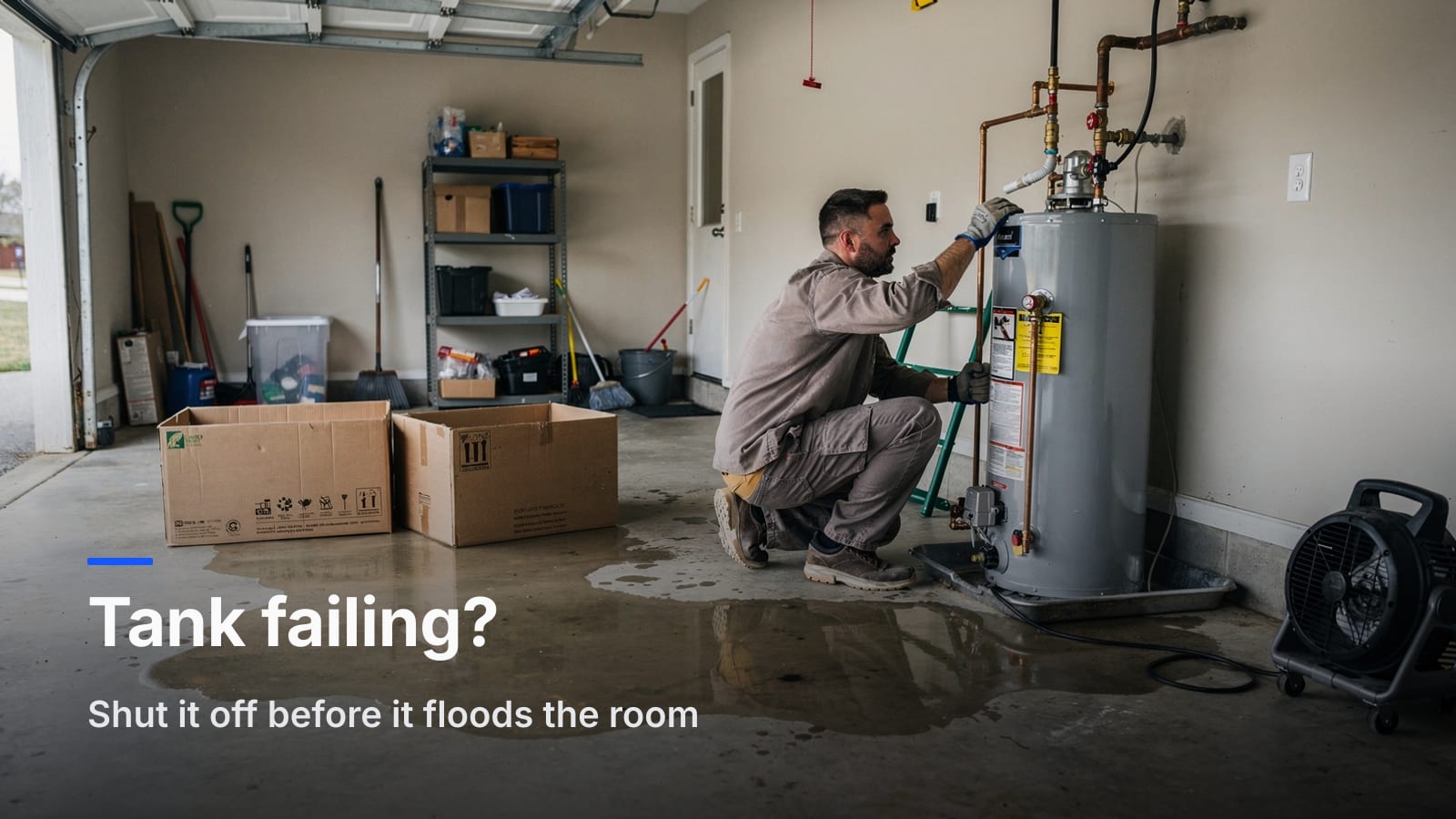
A 40- or 50-gallon tank failure is not a small spill. In a garage, that volume of water spreads across the slab, under stored boxes, into baseboards, and sometimes under a shared wall into finished space. In a utility closet or mechanical room, it finds the nearest doorway and travels into hallways, closets, or a finished basement before anyone notices, especially if the failure happens overnight or while you're away.
Water heaters are also commonly installed in or near crawl spaces and finished basements in Boise homes, which means a failure can wick into insulation, subfloor, and framing that stay wet long after the puddle on the surface is gone. If your unit sits near or above a finished lower level, read through our page on crawl space water removal or flooded basement cleanup to understand what hidden moisture can do if it's left to sit.
Drywall that stays wet for more than a day or two starts to soften and can become a setting for mold growth. Fast extraction and drying is the main thing that keeps a water heater flood from turning into a bigger mold problem later. Pulling the water and drying the structure quickly is the most effective thing you can do to prevent it from becoming an issue.
What to do after you've shut off the water and power
Once the cold supply is off and power or gas is cut, the immediate danger is handled. From there:
- Photograph the damage, including the tank, the water line on the walls, and anything stored nearby that got wet. This helps with insurance and gives you a record before anything gets moved or cleaned up.
- Move anything salvageable off the wet floor — cardboard boxes, rugs, stored items — before they wick more water or start to mold.
- Open a window or run a fan if the area is safe to be in, to start some air movement.
- If carpet, drywall, or baseboards in a finished space got wet, extraction and structural drying works best when it starts quickly. Standing water and soaked materials left for a day or two are a lot harder to fully dry out.
If you're not sure how bad it is, you can send photos through our photo help page and get a read on what you're dealing with before deciding next steps.
When to call for help instead of handling it alone
Shutting off the water and power is something most homeowners can do safely on their own. But call for help, and stay out of the area, if any of the following are true:
- Standing water is near outlets, a breaker panel, or anything electrical and you're not confident it's safe to be in the room.
- You smell gas, or you're not sure the gas valve is fully shut off.
- Water has been sitting for more than a few hours, or you don't know how long it's been there.
- The leak reached a finished basement, flooring, or drywall and you want it dried properly rather than just mopped up.
For the cleanup itself — extracting standing water, drying out a garage, utility closet, or basement, and getting moisture out of flooring and framing before it causes bigger problems — that's where we come in. You can see what that looks like on our emergency water removal and appliance and water heater leak cleanup pages, or check typical cost ranges for water damage cleanup if you're trying to plan ahead.
A water heater failure has a lot in common with a burst pipe in terms of how fast water spreads and how it hides in walls and flooring — our post on what to do in the first hour after a burst pipe walks through the same early steps in more detail, and is worth a read if you want a fuller first-hour checklist.
Questions
Can I replace the water heater myself after it leaks?
Installing or replacing a water heater involves gas or electrical connections and plumbing work, which is outside what we handle. We focus on removing water and drying out the structure and contents once a leak has happened; a plumber or installer handles the replacement unit itself.
Should I drain the tank before it fails completely?
If you can see clear warning signs — rust-colored water, rumbling, a damp base — draining the tank yourself through the drain valve can sometimes relieve pressure and buy time, but it won't fix internal corrosion. If the tank is near the end of its typical lifespan, plan on replacement rather than trying to extend it.
Does homeowners insurance cover water heater leaks in Idaho?
Many policies cover sudden and accidental water damage from an appliance failure like a water heater, though coverage details vary by policy and insurer. Our page on homeowners insurance and water damage in Idaho walks through what's commonly covered and what isn't.
Is a water heater leak an emergency if it's just a small drip?
A small, steady drip can still mean a corroded tank or failing valve, and it often gets worse without warning. It's worth shutting off the cold supply and keeping an eye on it rather than waiting for a bigger leak to force the issue.
What's the difference between a leaking fitting and a failing tank?
A leak from a fitting, valve, or supply line is usually fixable without replacing the unit and often stops once you shut off the cold supply. A leak coming from the tank body itself — the steel shell — means the tank is failing internally and will need to be replaced, since there's no way to patch a corroded tank long-term. If your water heater has already leaked or failed, send photos through photo help or contact us and we can tell you what the cleanup involves.
Cleanup help in Boise
- Water Heater & Appliance Leak Cleanup in Boise
- Burst Pipe Cleanup in Boise, Idaho
- Crawl Space Water Removal in Boise, Idaho
- Emergency Water Removal in Boise, Idaho
- Fire & Smoke Damage Cleanup in Boise, Idaho
- Flooded Basement Cleanup in Boise, Idaho
- Sewage Backup Cleanup in Boise, Idaho
- Structural Drying After Water Damage in Boise